Inside the intensely competitive world of contemporary serious sliding, podium finishes is no longer solely a product of sheer horsepower or pilot aggression. Instead, it has evolved into a complex discipline which necessitates a meticulous marriage of picking a proven vehicle platform, arming it with the correct performance parts, and, most essentially, understanding its real-time performance on the track through sophisticated suspension tuning applications. This exhaustive handbook acts as your master plan starting from the initial concept of a project car right through to the last engineering-refined adjustments that transform a capable car into a predictable champion. We will examine in detail the art and science of vehicle alignment optimization, illustrating how a state-of-the-art drift tuning app like GripDial removes assumptions and delivers unmatched visibility into your car's actual behavior.
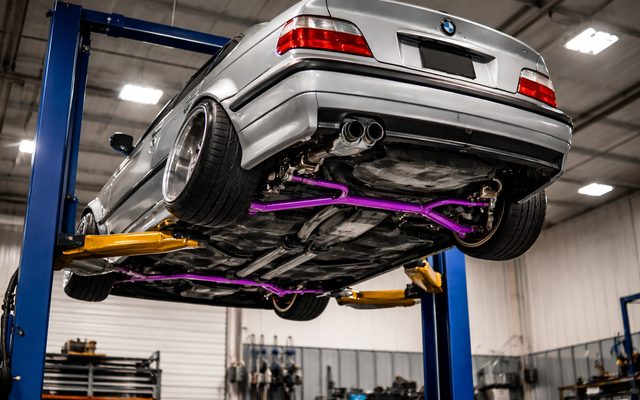
The cornerstone of any exceptional drift machine is, undoubtedly, the platform itself. Certain platforms have achieved legendary status within the international oversteer culture due to their natural weight distribution, strong build quality, and the immense range of performance support available. Selecting the right platform is the first and most crucial decision a driver will make. To illustrate, the the E36 generation BMW is commonly accepted as among the finest all-around cars for drifting of the modern era. Its almost ideal balanced front-to-rear weight, coupled with a rear-wheel-drive setup and extremely reliable inline-six engines, forms a car that is simultaneously forgiving for newcomers and extremely capable in the possession of a pro driver. The next step of this concept, the BMW E46, refines these attributes with a more developed chassis, increased wheel track for enhanced confidence, and even increased lock straight from the factory. A distinct dominant option in the pro circuit is the C6 generation Corvette.
This American sports car brings a particular combination of benefits to the sliding world, including a low-mass aluminium frame, a rear-mounted transaxle that helps create an perfect balance, and the immense torque of a large-displacement LS V8 motor. This combination renders it an utter monster on track, designed of entering and sustaining continuous angles with relatively minimal deployment of throttle. For those seeking exceptional value, the Nissan 350Z stands out as a prime example. It arrives from the manufacturer with a rigid body structure, a decent OEM LSD, and the free-revving VQ series motor that offers sufficient horsepower and torque for learning and moving up in the sport. Its newer version, the Nissan Z34, offers additional advancements in chassis stiffness, suspension design, and overall powerplant performance, cementing its place as a popular selection among professional pilots. Further legendary vehicles that deserve mention encompass the nimble Wankel-engined Mazda FC RX-7, the ubiquitous Nissan S13, the V8-powered Ford Mustang SN95, the more recent BMW E90, and the small yet surprisingly fun and forgiving Mazda Miata. Every single one of these chassis gives a different array of attributes, challenges, and potentials, but they all have in common the fundamental elements required to be transformed into a serious drift machine.
However, selecting the correct car is merely the beginning. To unlock the complete potential of any of these vehicles, significant modifications to the steering system and damping and springing systems are completely mandatory. This is where the domain of precision drift-spec hardware enters critical view. The one most impactful modification for a serious drift car is the installation of a high-performance drift angle kit. These sophisticated assemblies, like those engineered by industry leaders like SLR, are created to dramatically increase the chassis's available turning lock. A standard road car is extremely limited in how far its tires can rotate, a design limitation for on-road use. In drifting, however, maximum opposite lock is constantly required to manage and maintain a angle. An modification kit substitutes the factory uprights, linkages, and sometimes A-arms with components that enable the front tires to attain degrees of turn over 70 or even 80 degs, as opposed to a average stock setting of around 40 to 50 °.
This vastly greater lock offers the pilot with exponentially greater authority during a slide, enabling it to be far simpler to begin a drift, hold it through a sweeping turn, and change fluidly from one direction to another. The contrast in handling is nothing short of transformative. Combined with a properly chosen steering kit is the every bit as critical modification to the car's spring and damper setup. Off-the-shelf or even premium sport coilovers are simply not engineered for the specific and extreme needs of drifting. A purpose-built pair of suspension units is of utmost importance. These specialized coilovers have specific damping rates and spring stiffness that are designed for the rapid weight transfer that is characteristic of drifting. When a pilot initiates a drift, the car's weight is shifted rapidly to the front of the bend. Optimal performance coilovers control this transfer in a predictable way, enabling the vehicle to settle quickly and providing the operator clear feedback through the wheel and driver's seat. They furthermore enable precise tuning of ground clearance, rebound and compression firmness, and weight balance, which are all integral parts of fine-tuning the vehicle's handling to a specific track or competition approach. As a system, a top-tier angle modification system and a expertly selected system of competition adjustable dampers form the absolute mechanical cornerstone upon which all future optimization is built.
Once the core parts is fitted, the subsequent essential phase in the build is the meticulous setting of the chassis's wheel angles. This is the realm of chassis dynamics adjustment, a methodology that can appear intimidating to the beginner but is, in practice, the defining factor to converting a set of capable components into a harmonious and consistent vehicle. The most discussed aspect of suspension geometry for sliding is certainly camber angle. Wheel camber is the inclination of the rim in relation to the upright line when looked at from the front of the chassis. When the top of the tire is tilted towards the car, this is called camber-in. For sliding, negative camber on the steering wheels is generally employed and is regarded as critical. The reason is deeply related to vehicle dynamics.
When a vehicle is turning at limit slip angles, the frame rolls towards the external of the corner. This lean causes the outer front wheel to lose its ideal contact patch with the track surface. By applying negative camber, the wheel is pre-tilted to counteract this tilt. As the car leans into the turn, the outside front tire becomes more upright on the asphalt, maximizing its traction at the critical moment when it is most required for directional command. Typically, front angles for a competition drift car range from approximately -3 degrees to as extreme as -5 degrees or even beyond, contingent on the specifics of the car configuration, compound type, and driver style. The rear axle tires also employ negative camber, but the settings are typically more modest and more nuanced than the front axle. Overly aggressive negative camber at the rear can make the car excessively tail-happy and challenging to predict on acceleration input, as it shrinks the usable contact patch of the driving wheels during straight-line acceleration. Therefore, rear camber settings are frequently in the ballpark of -1 degree to -3 degrees, finding a careful equilibrium between providing adequate cornering grip to help in initiating drift telemetry software and holding the drift while still preserving effective traction for power-down the bend. alignment is merely one component of the more complex suspension geometry equation, which additionally encompasses toe, caster, and bump steer correction.
Toe setting is the angle of the wheels when looked at from a bird's-eye view. Positive toe means the front edges of the wheels are closer together than the trailing edges, while outward toe means the reverse. For drifting, a small amount of front axle toe out is frequently run to quicken the initial steering feel, making the vehicle feel more nimble and eager to begin a drift. Rear toe angle is generally set to zero or a very minute amount of inward toe to promote straight-line stability under throttle. self-centering is the frontwards or rearward inclination of the kingpin axis drift angle kits when viewed from the lateral of the car. Positive caster angle improves steering feel and stability confidence, and it furthermore boosts negative camber effect during cornering, which is extremely advantageous. Adjusting these settings is a complex dance where a change to a single setting can and often will impact the remaining parameters. The old-school process for tuning a chassis's alignment for sliding has historically been a time-consuming endeavor of guesswork and adjustment. A driver or crew would introduce a adjustment based on a hunch, drive the chassis on track, rely on the pilot's individual sensation and impressions, and then make a further adjustment. This loop would iterate over and over until the vehicle felt "acceptable" or the available testing time was exhausted. This system is not just extremely wasteful in terms of man-hours and tires, fuel, and parts, but it is furthermore fundamentally imprecise.
Human perception is a notoriously inconsistent measurement tool, influenced by numerous elements such as fatigue, changing track surfaces, weather, and merely the mood of the pilot on that specific run. What feels "loose" on one lap might feel "understeery" on the subsequent pass, leading to confusing information and counterproductive tweaks. This age-old challenge in vehicle dynamics optimization is exactly where state-of-the-art telemetry systems has stepped in to revolutionize the methodology.
The development and integration of advanced vehicle dynamics tools has brought about a completely new age for tuning and perfecting professional sliding vehicles. This new generation of platforms, showcased by cutting-edge systems like GripDial, function by directly recording the actual dynamic performance of the chassis as it is piloted on the circuit. In contrast to depending on personal impression, these tools gather objective metrics on essential factors such as suspension travel, wheel speed, lateral and longitudinal g-forces, steering angle, and throttle and brake input. This acquired information flow is then analyzed by powerful software that can plot and decode the data in a comprehensible way. For the first time, drivers and crews can observe exactly what the chassis is performing at any given millisecond of a lap. This ability transforms the complete chassis setup procedure. Consider the aforementioned task of dialing in the front axle camber for a particular vehicle. Rather than making a modification from -3 degrees to -3.5 degrees and then testing many laps to try and "sense" a difference, a telemetry system can deliver immediate and definitive feedback. The tool can display graphically how the wheel's contact patch is acting during the critical moments of a slide: the initial flick, sustain, and changing direction. It can show if the current angle is permitting the steering tire to achieve maximum loading or if the rubber is working inefficiently on its outer shoulder.
The system can subsequently make empirical advice for change. Perhaps the information shows that the outside front tire is still overworking its outer shoulder at -3.5 degrees of negative camber, implying that an increase to angle, say -4 degrees, might be beneficial. On the other hand, the information might show that the tire is failing to coming up to heat or that the inner edge is wearing unevenly, which could indicate that there is overly aggressive inward lean and a modest decrease back to -3.2 degrees would be more ideal. This standard of accuracy and practical intelligence was completely unimaginable in the time of pure seat-of-the-pants tuning.
The effect of utilizing a advanced drift telemetry system goes much further than merely dialing in alignment. It becomes an priceless coilover setup tips that is customized to your particular chassis. When fine-tuning the shock absorber values on your coilovers, rather than relying on imprecise advice or replicating another driver's numbers, you can use the software to see how the vehicle is behaving in reaction to your adjustments. The application can show the wheel movement trace over a run, revealing if the shocks are handling the body movement optimally or if they are allowing the vehicle to bounce too much after a direction change. It can aid in identifying challenges like bottoming out or losing droop, permitting you to make educated decisions to helper springs, damping values, or ground clearance. This process translates equally to the intricate task of corner balancing. Beyond camber angle, the system can give insight into how modifications to toe and caster angle are affecting the car's handling during various parts of a drift. For instance, it can help you to ascertain the best amount of front toe out for your individual angle kit setup and competition style by analyzing the response time of initial response and the predictability of the vehicle at full countersteer. This turns the software an extremely powerful performance optimization handbook that is actively calibrated by the real-world dynamics of your personal chassis on the circuit. It elevates the whole project from a dark art into a scientific engineering procedure.
Furthermore, the value of a system like modern telemetry is in no way limited to professional teams with large funding. For the club-level driver, it serves as an powerful force multiplier. It practically offers the builder with the insight of a expert dynamics engineer without the corresponding cost. It drastically shortens the development time by delivering unambiguous directions to problems that would normally take years of experimentation to answer. A tuner can learn how their individual chassis reacts to different adjustments, gaining a deeper knowledge of vehicle dynamics in the endeavor. It furthermore democratizes professional suspension engineering principles, permitting all drivers with the drive to optimize their machine to do so in a systematic and productive fashion. This is notably valuable in a activity like sliding, where setup know-how has historically been a tightly held commodity among elite teams. Today, that power can be suspension tuning tool in the garage of every dedicated driver.
In conclusion, the path to constructing and dialing in the ideal competitive drift machine is a multi-stage project that smoothly integrates time-honored engineering principles with revolutionary telemetry tools. It commences with the strategic choice of a legendary chassis, then enhanced by the application of critical performance hardware like drift-spec drift angle kits and correctly specified performance suspension units. The process then advances into the intricate phase of chassis dynamics adjustment, where parameters like camber, toe, and caster are carefully set to complement the chassis's upgraded capabilities and the driver's individual technique. Ultimately, and what genuinely distinguishes the contemporary methodology from the traditional methods, is the use of a powerful suspension tuning application. This system removes the uncertainty and waste of solely feel-based tuning by providing objective, real-time data on how the chassis is really functioning. It functions as an unparalleled diagnostic aid, a definitive coilover setup manual, and a comprehensive vehicle dynamics tool. Together, this holistic philosophy guarantees that each and every aspect of the drift car—from the pick of the platform to the final click on the suspension—is refined for maximum performance on the competition venue. It signifies the full progression of the discipline of drifting, connecting physical driving skill with surgical vehicle setup to build the most competitive cars possible.